What are Bagel Saturdays?
On the first Saturday of every month, we come together to talk about what is happening in our communities and what we are going to do about it. No panels. No performative networking. No safe distance between the conversation and the consequences. Just people. Information. Action.
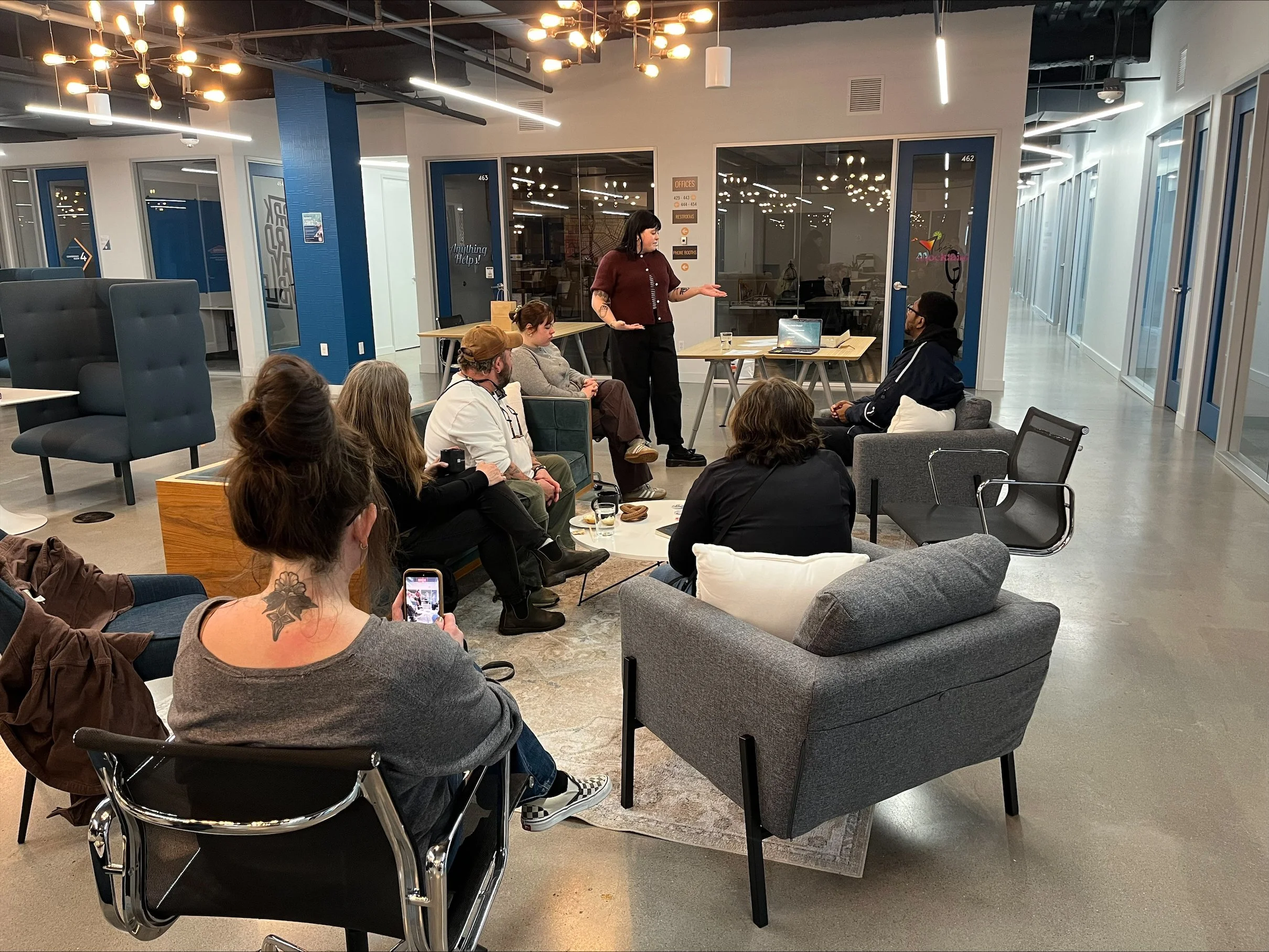
On Saturday, April 4, we community members gathered for our first Bagel Saturday and to answer the call to stand with the Prairieland Defendants.
The Prairieland Case (What Is Actually Happening)
On July 4, 2025, a protest took place outside the Prairieland ICE Detention Center in Alvarado, Texas. At some point during that protest, property damage occurred and a law enforcement officer was shot.
Folks were then charged in an Indictment that treated the event not as a protest that escalated, but instead as a coordinated act of domestic terrorism. Nine people have already been convicted on most counts. They are now facing decades in prison. Others are still fighting their cases. The charges are not minor. They include attempted murder of federal officers, weapons charges, and terrorism-related allegations.
But the real story is not just the charges. It is the theory.
The government is advancing a narrative that collective protest activity—particularly protest aligned with anti-ICE or anti-fascist movements—can be reframed as organized, violent conspiracy.
That matters.
Because once protest becomes conspiracy, and conspiracy becomes terrorism, the rules change.
The Legal Reality (This Is Where It Gets Dangerous)
Let’s be clear about what is at stake.
The First Amendment protects the right to assemble, to protest, to speak out against the government. That part is not new.
What is changing—what cases like this are testing—is how far the government can go in collapsing group activity into criminal liability.
You do not have to pull the trigger to be charged.
You do not have to plan the entire event to be swept in.
Under federal conspiracy law, aiding and abetting theories, and expansive interpretations of “material support,” you just have to be close enough, connected enough, or present enough for the government to argue you were part of something bigger.
And once those charges are on the table, everything escalates:
Pretrial detention becomes more likely
Bail becomes harder or impossible
Sentencing exposure jumps from years to decades
The narrative shifts from “protester” to “threat”
If you are out in these streets—standing up for your rights and the rights of your neighbors—you need to understand that shift.
Because this is not just about what happened in Texas.
It is about what can happen anywhere.
Why This Hit Home in Minneapolis
Immigration enforcement is not abstract here in Minneapolis. It has impacted families, neighbors, entire communities. People have been detained, disappeared into systems that are difficult to navigate and even harder to fight.
We know what it looks like when enforcement becomes personal.
So we are not going to pretend that a case like this is “over there.”
It is not.
What We Did (And Why It Matters)
We started with the facts.
Our law clerk, Greta Lahm (Mitchell Hamline Class of 2028), walked through the case—what is known, what is contested, and what is at stake.
Then we opened the room.
Questions. Real conversation. Space to process something that is still unfolding.
Then we got practical.
We held a Know Your Rights session focused on protest and First Amendment activity. Because showing up is powerful, but showing up informed is how you protect yourself and the people around you.
And then we did something simple and human.
We wrote letters.
To people who are sitting in prison cells right now, facing the weight of the federal government.
To remind them they are not forgotten.
To remind them they are still part of this community.
To say: we see you, and we are still here.
If You Are Protesting, Read This First
If you are showing up to protest or to act as a constitutional observer—especially around issues like immigration, policing, or government power—you need to understand the legal landscape you are stepping into.
1. You do not have to say anything. Use that right.
You have the right to remain silent. Use it. Ask for a lawyer and stop talking.
2. You can be charged even if you did not “do” the main act.
Conspiracy and aiding and abetting theories allow the government to pull people in based on proximity and association.
3. Phones are evidence.
Texts, group chats, location data, and social media can all be used against you. Be cognizant of how you are communicating and the platforms you are communicating on.
4. Law enforcement can lie to you.
They can say they are helping you. They can say you are not in trouble. That does not mean you should talk.
5. Ask for a lawyer. Then stop.
Say it clearly: I want a lawyer. Then stop talking.
6. Showing up matters. Being informed matters more.
Know your rights before you need them.

This Is the Point
Bagel Saturdays are not about feeling informed.
They are about being prepared.
They are about understanding the risks, the law, and the reality. And still deciding to show up anyway, but smarter, sharper, and together.
Join Us Next Time
Our next Bagel Saturday is May 2.
If you are organizing—come.
If you are unsure where you fit—come.
If you just want to understand what is happening—come.
Sign up for our newsletter to stay in the loop on future Bagel Saturdays and other community events.
We will be here.
We will keep showing up.
And we will save you a bagel.
Disclaimer
This post is for general informational purposes only. It is not legal advice, and reading it does not create an attorney-client relationship with Lotus Legal PLLC.
If you want to change that, request a consultation.